Examining Bias in a Global Perspective:
from newspaper articles, a novel (The Cay, by Theodore Taylor), to our own stories

(an eight lesson unit for seventh grade Language Arts with applications in Social Studies) 

Unit Objective: In this unit, students will begin to identify features in a variety of  literature, from newspaper articles, novels, and even student writing as cultural filters, reflecting author bias, or partiality, in world history.

Rationale: Readers often do not take time to consider the partiality of the author, and rather, simply react to it unconsciously.

Class Description: A seventh grade language arts class of thirty students, designated as gifted, at East Hall Middle School, Gainesville, Georgia, participated in a test run of the first six lessons of this unit. The resulting lesson plans have been modified according to the successes, failures, and improvisations in these classes. Designing this unit would not have been possible without the cooperation of Mrs. Fraga and Mrs. Smith, the regular Language Arts teachers, and the students. See a detailed class description in the appendix sec.1.


Pre-test: Students are asked in class, orally, to give as many examples as possible of bias in any media and/or literature that they have read. Students are also asked to consider their own writing as a source of bias, or partiality, as well. On a piece of paper, students will brainstorm the following two topics: 1) "bias in media and literature," citing as many examples as the can; 2) "bias in my own writing (how does my own show a bias?).

Lesson summary:

  1. In the first lesson, "Making Something of the News: Thinking Analytically and Creatively about the News this Week," we analyze various newspaper articles in groups to consider the article's subject (for inherent conflict); prospective audience; and author (for his or her bias) (cognitive domain). Also, teams of four groups each synthesize article content into chain stories using elements from the articles (affective domain).
  2. In the second lesson, "The Cay, by Theodore Taylor: First Impressions from a Globals Perspective," we analyze the first page of a novel which we will be reading over the following few weeks. We consider the author's dedication and the first page of the story to identify his potential bias or partiality (cognitive domain). To see the bias more clearly, we study the world historical context of the setting and plot of the story, which takes place in the Caribbean during the Second World War. We begin drawing a world map which better contextualizes the countries in the story (psychomotor domain).
  3. In the third lesson, "Reconsidering simile in a world economic context," we probe deeper into the context of the Second World War to reconsider a simile the author uses in the first sentence in which German submarines are likened to "hungry sharks." We finish creating our world maps and see how the power play of European nations comes to a head in the First and Second World Wars (psychomotor domain).
  4. In the fourth lesson, "World War, Escape, and Survival: Using the model plot of The Cay to make our own stories," we identify a story pattern (e.g., a world war context, an escape to another country, and drifting on a survival raft) (cognitive domains). We use this pattern, or model, to begin constructing our own stories (affective domain).
  5. In the fifth lesson, "Beginning the Editing Process," we begin to develop our stories using a process of peer advising and rewriting (cognitive domain).
  6. In the sixth lesson, "Writing Fevers: The Cay and our stories," We contextualize in world history chapter 12 of the book in which Timothy, the elderly African man, overcomes a bout with malaria. We compare the different immunities of the different groups in the Caribbean -- native, European, and African (cognitive and affective domains). We present drafts of our stories to the class for further recommendations (affective domain).
  7. In the seventh lesson, "Story-telling the final draft," we develop a criteria for what makes a good story-teller and then we evaluate student presentations of their stories (cogntive and affective domains).
  8. In the eighth lesson, "Two Voices of The Caribbean: Theodore Taylor and Bob Marley," we discuss the theme of racial reconciliation in The Cay and analyze elements of a song called War by a famous Caribbean musician, Bob Marley. We also begin to analyze our own writing for its unique biases, or partialities, in a world historical or global context by comparing it to stories written by students in Japan (cogntive and affective domains).

Post-test: 1) Students' creative writing projects are evaluated according to the progress they made on the writing process. 2) Students are asked to recall concrete examples of bias in any form of media, literature, and their own writings during the course of the unit.


Main QCC (Quality Core Curriculum) Connections in Language Arts (LA) and Social Studies (SS) for Georgia:

Initial Reading and Outlining of Articles:

  1. Evaluates messages and effects of mass media (newspaper, television, radio, film, and periodicals) (LA 8.19).
  2. Analyzes literal, inferential, and critical questions (LA 8.20).   Analyzes relevance of data (LA 8.42).  Analyzes fact and opinion, persuasion techniques, bias, and stereotyping (LA 8.43).
  3. Explains how cultures and values are represented in literature (LA 8.27).
  4. Examines cultural achievements made by Georgians in such fields as art, music, literature, theater, motion pictures and television - past and present (SS 8.42). (We use Georgia newspapers in our media analysis)
  5. Identifies and chooses literature according to personal interests (LA 8.30).
  6. Reads a variety of materials for information (LA 8.31) and pleasure (LA 8.32).

Oral Presentations and Discussions:

  1. Works within a group, following set rules of procedure, to complete
    an assigned task.  Presents viewpoint to others. (SS O).
  2. Expands speaking vocabulary (LA 8.56).
  3. Communicates effectively through oral expression (LA 8.57).

Writing Assignments:

  1. Responds creatively to literature (e.g., drama, art, multi-media projects, and essays) (LA 8.29).
  2. Uses a writing process that includes prewriting, drafting, revising, editing (can involve peer editing), proofreading, and publishing (LA 8.64).
  3. Uses literary elements and techniques such as plot, setting, theme, character, characterization, conflict, figurative language, and point of view to analyze literature (LA 8.23).

Lesson 1: Making Something of the News

Thinking Analytically and Creatively
about the News this week

Goals: to become interested in reading the news more creatively and analytically on a regular (weekly or monthly) basis; and thereby be more aware of the author's bias in media.

Objectives: After reading and analyzing a newspaper article in an area of the group's interests, students will:

  1. analyze an article for a) Subject (potential conflict); b) Audience; b) Author's bias or partiality
  2. make a brief presentation to the class
  3. in each group in each of the two teams in the class (four groups of three per team) contribute one sentence in a chain story utilizing some of the content from the article creatively
  4. identify elements of the finished chain stories (e.g. setting, theme or plot, conflict, resolution, etc.); and votes on the best one. The chain story will help the students make connections between articles and increase their enjoyment of reading newspaper articles.

Rationale: Students do not often pause to read newspaper articles much less consider author biases.

Context:  The class should already be divided into editing groups for various writing projects throughout the year.  Each group has a "mail box" (file folder decorated by the group) in which printed e-mail, assignments, and other printed matter is "delivered" to the group by the teacher periodically.   Every Monday morning (or on the first class after the weekend, they receive an short article selected by the instructor from the Sunday newspaper.  The articles should relate student/group interests.

Class flow for 50 minute period:

  1. 5 minutes: brief discussion of the news that students may have noticed over the weekend or preceding week.
  2. 20 minutes: students get into their groups and read over their article.    One student (designated on a weekly, rotational basis) fields opinions from each group member regarding the significance of the article.  Groups should identify: 1) the subject (and potential conflict of interest); 2) the audience; 3) the author (bias or point of view). One student in each group also contributes a sentence to a chain story that is being circulated.
  3. 5-10 minutes: groups present the three points they analyzed in their articles
  4. 5 minutes: instructor reads the chain stories students have created using content from their articles. Students vote on the best one.

Formative Assessment: 1) responsible group participation; 2) three parts identified in article; 3) group contributes one sentence toward the chain story.

Management Plan: Group work on a new project requires constant monitoring of group activities. I keep a constant view of the class as a whole as I interact with group leaders throughout the activity.

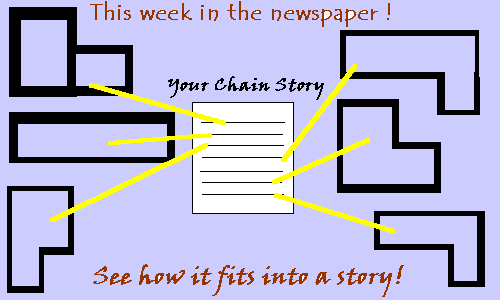
Follow-up uses of the lesson: Articles and chain stories can be posted on an "In The News This Week" bulletin board and/or web page.


newspaper.gif (6563 ¥Ð¥¤¥È)


Data from teaching this lesson plan
(East Hall Middle School, Grade 7 Gifted Class,
Monday, November 2 1998)
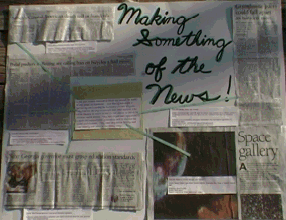
wwnews1.gif (39805 bytes)Team A story:

Long Ago, in a place far, far, away, there was a very abusive cat who always tortured a small child.  The cat dreamed of building a micro golf course on the child's head!   The golf course was to include a space program in which John Glenn would run around burning people, including the President and Hillary Clinton.  The KKK found the cat and made it their mascot.

Team A1 (Brittany, Mindy, Whitney):

Article: Your pet needs training for a new arrival, too

Audience: pet owners; people with pets and small children
Author/Voice (Bias): Pamela Warrick/warning voice
Subject/Motivation/Conflict: People don't realize dangers that pets have on babies.   Pets may get jealous. Subject--train your pets to be nice to newborns.

Team A2 (Ashley, Joseph, and J.J.):

Article: A proposed development will offer golf course living inside the city limits of Gainesville

Audience: people who play golf or are interested in golf or golf courses.
Author/Voice (Bias): Perce Adams/in favor of golf course in Gainesville
Subject/Motivation (Conflict): whether or not to put a golf course on land inside the Gainesville city limits

Team A3 (T.J., Crystal, and "Slick Willie" Bill)

Article: America looks a lot better here in the space age

Audience: general public aware of John Glen's flights
Author/Voice (bias): Cynthia Tucker/against racism
Subject: changes in racist tendencies in America between John Glenn's first and last space flight.

Team A4:

Britney, Misty, and J.J.

Article: KKK rally brief, nonviolent, but vocal (sub-title: Members yell slogans to small audience; Protesters pray, sing against Klan's cause

Audience: general public
Author/Voice: Charles Duncan writes against the KKK acts.
Subject/Motivation: inform about the KKK rally and related protest
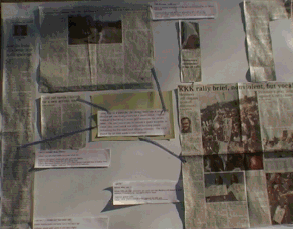

wnews2.gif (37494 bytes)Team B story:

In the past month, Hurricane Mitch has caused the death of 231 people in Honduras. One family managed to survive by out-running the hurricane on their bicycles. They rode all the way to Georgia and voted against Zell Miller because he would be bad for the schools in which the children would attend. They also urged their legislators to support the international greenhouse pact to improve the global environment. They were very active family and lived happily ever after in the Milky Way.

Team B1: Tyler, Tara, and Jordan Byrers

Article: Mitch's Central American death toll in hundreds

Audience: Honduran people and people interested in the Hurricane
Author/Voice: Freddy Cuevas, sympathetic to the people in Honduras
Subject/Motivation: inform general public about the tragedy

Team B2: Clarissa, Holly, and Elizabeth

Article: Pedal pushers in Beijing are calling ban on bicycles a bad move

Audience: Cyclers in China and people interested in China
Author/Voice (bias): Henry Chu (Los Angeles Times).
Subject/Motivation: urging people to bring bikes back to the streets of Beijing

Team B3 (Johnny, Dujuana, and Ana):

Article: Next Georgia governor must grasp education standards

Audience: people interested in education and voters concerned about the next governor
Author/Voice: Doug Cumming
Subject: next Governor as he relates to education

Team B4 (Natalie, Kevin, and Jordan):

Article: Greenhouse pact could fall apart as nations meet (subtitle: On a collision course -- Developing countries say they won't give in to U.S. insistence that they cut emissions more.)

Audience: environmentalists and people interested in the international agreement on greenhouse gases
Author/Voice (bias): Jeff Nesmith/against the agreement)
Subject: effect of greenhouse gas agreement on economy

Team B5 (Rebeca, Asheley Morgan, and "Spider"):

Article: Space Gallery (sub-titles: Cosmic bubbles; Bejeweled sky; Rings of Saturn; Celestial egg).

Audience: general public
Author: likes space
Subject: interesting things happening in space


Reflection after teaching the class:

This was my first experience teaching the class and the project was more than the class could handle in 45 minutes.  We needed the first ten minutes to warm-up, write our name tags, and introduce the project.  The students also needed extra coaching to analyze the articles and write the chain story.   We had to simplify our analysis to three areas (initially not included in my lesson plan): Audience; Author/Voice (bias); Subject (conflict).  The students identified these areas to varying degrees of proficiency. Each group managed to complete most, but not all, of the sentences in the circulating chain stories. I had to use the beginning of the next class to present the chain stories to the class. They enjoyed them and our analysis of the articles remained a useful introduction to considering the bias of Theodore Taylor's novel, The Cay, as well as our own stories two weeks later.


Lesson 2: The Cay, by Theodore Taylor: First Impressions from a Global Perspective

Main Objective: Identify the author's perspective in the novel, The Cay, in a global, or world historical context.

Rationale: Most students simply react to the story of a novel and do not consider biases in broader contexts.

Introduction: Today we are going to apply our analysis skills to a new novel.   We will try to analyze the author's bias just like we did with the articles, and enjoy the story.  I brought some music from the area where the story takes place.  

5 minutes (Mystery Music)
Objective: stimulate interest in literature indirectly through music (which is, arguably, a form of literature in its own right).

Class Flow: Let's try to guess where this music originates from. Don't yell out any countries until after we listen for a minute.  After a minute or two, students begin guessing instruments and Caribbean countries.

5 minutes (Begin story analysis with the dedication): I read the dedication and we discuss its significance in terms of cultural bias.

Class Flow: The dedication of the book to Dr. King in 1968 may reveal some clues to the historical or cultural bias of the author.  Do you think this story might appeal to a member of the KKK? (In the previous article, we read an article involving the KKK in our county.) In this context, we can identify Theodore Taylor's bias, a bias that the class shares unanimously.

10 minutes: We continue our analysis of the novel with the first page of the story. 

Class Flow: The first sentence clues us to another bias.  The author portrays the German submarines negatively or at least offensively, in the simile, "like hungry sharks." We continue on to the first page of the story and try to understand the geographical setting and historical context.  There are Dutch and Germans on an island in the Caribbean in 1942.  Many students do not know where Holland is, nor why Europeans are in the Caribbean, so I guide them on a quick tour of world geography and history to give us the necessary perspective for further analysis.

20-25 minutes: Map drawing and quick exploration of European expansion in the modern world.

How did humans from all over the world end up fighting in the Caribbean? We need a broad world historical context for our analysis of European and African/Native Caribbean world views during the Second World War, so we take a quick survey of human history beginning with Africa.  I ask the students, "In all of  human history, where did humans live the longest and why?"  A few students answer Africa.  We look at the globe and discover that it is the largest continent on the equator.  This helps explain why during the last two or three ice ages, human ancestors developed here.  It was the warmest, most hospitable place to live. We begin our map by drawing the equator and Africa ("shaped like an elephant's ear"); then we move out of Africa to Europe with the human migrations around the world during the last two ice ages. We proceed from Egypt, tracing the outlines of the countries on the Mediterranean Sea: Greece (the foot); Italy ("the boot for the foot"); around the Iberian peninsula of Spain and Portugal, up to France, Belgium, Germany, Holland, Sweden, Finland; and then cross the English Channel to the two main islands of Britain. Now we pause to consider how these Europeans (and Africans) ended up fighting in the Caribbean.  What could they have wanted there and why did they call the islands the West Indies? We figure out the connection to India and recall that Columbus died thinking that they were islands near India. We talk a little about the world economy that linked Europeans with Africa, Asia, and the Americas through spices, tea, and sugar. The latter product required plantations in regions with warm climates. South and Central America were perfect for nationally sponsored sugar cane plantations the Spanish called encomiendas. We continue drawing our maps from Eastern Africa to India, the initial destination of the Europeans. (The next class continues the map exercise).

Formative Assessment: 1) Varying levels of student participation in class discussion; 2) Clearly drawn world maps with labels for the continents and countries we are discussing.

Management Plan: 1) engage the students constantly with questions in my lecture/discussion; 2) utilize the regular teacher's management strategy in case of problem (stop the action by raising one hand until the class becomes silent).


Reflections on teaching the second class: The class went very well. Students enjoyed hearing the finished chain stories their teams had written during the preceding lesson. The sample of Caribbean music also stimulated our thinking and heightened interest in the novel.  The reading of the dedication made the author more accessible to the students; I read the first page was dramatically and held the students' attention. Questions arose naturally from our reading of the first page that led naturally to our exploration of the world in the map drawing exercise.


Lesson 3: Reconsidering Simile in a World Economic Context

Main Objective: continue identifying the historical context of the novel, especially the First and Second World War as they relate to the countries in the story; apply our review of the Second World War to reconsidering the simile in the first sentence.

Rationale: We often take it for granted that Germany was an "evil" country because of the atrocity of the holocaust during the Second World War. This aside, the global situation leading up to the World Wars gives a more balanced view of the German situation and alows us to see the potential bias of the simile in the first sentence of the story.

20 minutes (listen to tape recording of story, The Cay, chapter 2): straightforward, listening to story.  Students follow along with the text.
Objective: 1) improve listening skills; and 2) think critically in a global context about elements of the story.

5-10 minutes (Open discussion of the last part of chapter two as it relates to the Second World War at the time): I ask the students about the boat Phillip and his mother were on and where was the boat going to stop first. Some can recall that the boat had to stop in Panama to drop-off some pumps.  We discuss the significance of the pumps to Panama and the big picture of the Second World War. We decide that the boat is in serious danger of being torpedoed by German subs.

Formative Assessment: Class participation in the dialogue above.

15-20 minutes (continue our explorations of the world and the world economic situation leading to the First and Second World War):

Class flow: Recall with the students what the Europeans were seeking in India and how a world economy might develop from such a market. Students name various products including sugar and the need for sugar plantations, etc. We talk about the gold and silver the Spanish and Portuguese took from the Americas, the invention of the steam engine in England, and later the combustion engine, repeating rifle, etc. that brought more and more European countries into what came to be known as a Great Game of industrializing nations scrambling to control the resources of the world. Holland, Germany, Belgium, France, Spain, Italy, Japan, and America became the main players until the First and Second World Wars ended the games. (We continue drawing our maps now from India to see how the players divided their influence on the world. We find England in India, France and Holland and Germany in SE Asia and the Pacific, and a wide range of players in the Americas and Africa.) (I brief the class on the situations leading to the First and Second World Wars.) When there were no more lands to be taken, European powers fought it out in the First World War. Germany lost and the winners divided up the German possessions. But Asian people who helped European nations fight the war felt cheated because they could not get a racial equality clause in the Treaty of Versailles. (European powers talked big of equal human rights and independence to many colonies after their help during the First World War, but they didn't follow through.) The winners took their winnings turned inward as the world economy collapsed. In the meantime Asian nations and Germany had to find alternatives. The U.S. and Britain ended oil exports to Germany and Japan and they had to find new sources for other raw materials as well. Germany sought to regain its national pride and mistakenly looked to their ethnic racial identify as superior to anyone who looked or believed differently. As Asian peoples were discriminated against in the U.S., Japan began to view their ethnicity as superior. Japan began to expand into China and Indonesia and Germany invaded surrounding European nations, including Holland and torpedoed oil facilities that supplied the British.

We have to remember that countries, including the United States, did not yet have the scientific knowledge that we have today to see that the human race is inter-related that the surface differences of skin and eye shape have no more significance than the differences in our hair color. We were also more dogmatic about our religions and did not see that all peoples' religions were valid.

Objective:
students will take illustrative notes on their world maps and be engaged in the lecture.

Discussion Questions: I ask the students if they can see how the first sentence of the text can be viewed as showing the American bias of the author. If we were to rewrite the first sentence from a German bias, how might we do it? Students write the sentence using a new metaphor.

Formative Assessment: 1) participation in class discussion; 2) relevant illustrations on their world map incorporating elements from the lecture; 3) each student writes a new simile for Germany

Managment Plan: 1)active engagement through eye contact and questioning at all learner levels during the lecture/discussion; 2) the regular teacher's method of raising one hand if discipline can not be sustained.

Sponge (or homework for next lesson): If there was a war here in North America and you had to escape, where would you try to go and what would you pack in your emergency raft?   Draw a picture of your boat on your world map; and add color and illustrations to your world map and make it reflect your view of the world.


Reflections on teaching the third lesson

The class responded well to the lecture and I was able to make it interactive enough to keep them engaged. But it was all I could to "pull it off." The content is thick and I had to be creative and dramatic in the presentation. We did not have enough time in the lesson to write new similes. In future lessons I will have to manage the time more effectively if I am to make writing the new simililes an essential part of the lesson plan. We spent about five minutes at the beginning of the class on the sponge activity which will form the basis of our creative writing project in this unit.


Lesson 4: World War, Escape, and Survival: Using The Cay's model plot to create our own stories

Main Objective: Identify the developing plot in The Cay and apply it in the creation of our own stories.

Rationale: Students do not often imagine writing a novel like the one they are reading and The Cay provides an ideal model for considering student views of the world.

20-25 minutes: Listen to Chapter 6 of The Cay and discuss the story pattern that has unfolded in The Cay. (e.g. world war context, an escape to another country, ship-sinking and adrift on a life raft).
Objective: 1) reflect on the overall flow of the story; and 2) identify elements from it that we can create a model for our own stories.

Class Flow: During our discussion, we write a story outline on the black board.

20-25 minutes: Begin writing outlines and/or stories individually.
Objective: Using the story model we identified for The Cay chapters 1 through 6 and the content from a sponge activity the previous lesson, we write an outline of our own story.

Class Flow: students work individually at their desks in drafting their stories. Other questions to help students develop the stories: What kind of war would it be, what countries would it involve; how do you make your escape; where are you going and why? How does your boat sink; and who else is in your life raft?

Formative Assessment: At varying levels of proficiency, students apply the story model of The Cay in the writing of their own story outlines and begin the first stage of the writing process in writing their own stories.

Management Plan: 1) field opinions from all students at every learning level in the construction of the plot outline; 2) work with students individually as they begin to construct their own story outlines and stories; 3) use the regular teacher's plan in case of emergency.


Reflections after teaching the fifth lesson:

The class went smoothly. Students were able to identify a story model in the first six chapters of The Cay and apply it to the writing of their own stories. They worked well individually writing their initial outlines and drafts of the story.


Lesson 5: Beginning the Editing Process

Main Objective: given the first draft of our writing, be able to accept constructive criticism and react to it constructively.

Rationale: Seventh grade students are not yet accustomed to the routine and rigor necessary for effective writing.

20-25 minutes: Listen to Chapter 8 of The Cay and discuss informally survival food of the island (i.e., Logosta, or Lobster), and survival food that we might be willing to eat on our life raft and in the wilderness.

Class Flow: After fielding student ideas on wilderness survival food, suggest that they might be able to implement some of these ideas into their own stories.

20-25 minutes: Read a story that the teacher has authored using the model form of The Cay . Ask the students to evaluate it in terms of the following criteria:

  1. Was the story understandable?

  2. How could the world war context be improved?

  3. How could the escape to another country scenario be improved?

  4. How could the survival raft scenario be improved?

If a student volunteers his or her writing, read aloud and get the class to evaluate it using the same and other criteria.

Formative Assessment: Students exhibit willingness to participate in the editing process of someone's story by providing suggestions for improvement and responses to suggestions from peers.

Management Plan: field opinions from students at every learning level to give advice to someone trying to make their story more appealing to them.


Reflections after teaching the fifth lesson:

Students enjoyed listening to and critiquing the instructor's story. It was an effective stimulus for proceeding with the writing process.


Lesson 6, Writing Fevers:
The Cay and our own stories

Main Objectives: 1) Think about the Malaria fever scenario in the story in a context of world history to identify the significance of ecology in Caribbean on different groups of people. 2) Begin to identify cultural features of student-authored stories in a global context. 3) Continue the editing process.

Rationale: 1) The topic of malaria and other diseases is an important factor in understanding the interaction between, Europeans, Africans, and native Americans. 2) Student-authored stories using the model of The Cay provides an ideal data base to construct a picture of our class's world view. 3) The editing process requires continued guidance.

Introduction: This class is content-packed, so I go over following outline of the class is written on one side of the board: 1) Improve our listening skills with Chapter 12 and try to relate to it personally. 2) Samples of your writings in a global context. 3) a. The writing process part 2: Mr. Adams responds to our critique; b. we try editing a story.

1a) 5 minutes: listen to the cassette recording of Chapter 11 of The Cay
Objective: improve listening skills and enjoy the book.

Class flow: straightforward listening to the recording and following along with the book. Students may also work on their question sheet.

1b) 10-15 minutes: and discuss the experience of fever and malaria personally and in world history.
Objective: be able to see the ecological connection between Africa and the Caribbean; in particular, why the Africans were able to survive better than any other group in the new world.

Class flow: (the dialogue) Has anyone had an experience with a high fever?  (The answer is unanimous). How about a high fever? (One boy responds that he had one go up to 107.) I recall my last high fever and explain that our bodies are trying to burn off some invading microorganism. And these microorganisms vary around the world. Where are they especially active in the world? (Students able to answer equatorial regions). Right, especially equatorial regions. What kind of microorganism was Timothy's body trying to fight off in the story? (students respond Malaria) What is malaria and where is is it usually found in the world?) (students respond that it is a deadly microorganism and that it is found in equatorial regions of the world, including Africa and the Caribbean) Yes, the news is now that after Hurricane Mitch, the standing water may cause more death through malaria than the hurricane itself. With medicine, almost anyone can survive Malaria, but two hundred years ago only people with immunities attuned to the equatorial climates of the world could survive. What groups of people might that be? (Students guess native Caribbean people and Africans) Yes, until the discovery of drugs to combat Malaria, the Europeans died off even faster than the African slaves in South America.  (I ask the regular teacher, with whom I discussed the topic on the previous day, "What was the name of the drug was the saved her father from malaria during the Second World War?) She replies, "It was quinine, and it saved my father from malaria 34 times!). And without quinine, your father would probably have died. Two hundred years ago, before there was quinine, people of African descent had the best chance of surviving Malaria working in the sugar plantations near the equator. That helps explain why slavery became such a big business. What about the native Caribbean people? Why couldn't they survive? (Students figure out that their immunities were not strong enough from the European and African diseases.) Yes, small pox killed from 80 to 90 percent of the population during the first hundred years of contact with the Europeans. One Spanish priest sympathetic toward the Indians in the Caribbean mistakenly argued that they were delicate like European nobles and were therefore not fit for slavery.  Introduce the sources of the Spanish priest's words and another sources that explain the ecological impact of the Old World (Afro-Eurasia) on the New World (the Americas). Put books related to the discussion on display at the front of the room for students to borrow if they choose.

Formative Assessment: Students respond to continuous questions in the discussion.

2) 10-15 minutes: Give some samples of the students' writing so far and the developing impression of the world evidenced in the students' writing. Objective: begin to identify cultural biases in the classroom from a global context.

wwmap.gif (34686 bytes)Class flow: Sample the students' view of the world as portrayed in their writings in comedy and more serious concerns. Three contexts (in the display poster) reveal the students' cultural biases: 1) the world war context; 2) the country to which they chose to escape; and, 3) the "essentials" they chose for their survival raft.

  1. The World War Context: Students (in my class) identified (in order of frequency) Germany (4), Iraq (3),   Russia (2), Canada (2), the Caribbean (1),  Spain (1), and China (1). What does our choice of these tell us about our view of the world? (Students respond that Germany, Iraq, Russia, and Canada, are suspect in their minds. Canada is suspect because "they are too nice!"
  2. Countries to which they escaped (in order of frequency): Antarctica (2), New Zealand (2), Australia (1), Germany (1), France (1), Ireland (1), Russia (1), The North Pole (1), South America (3) [Venezuela (1), Brazil (1)], Central America (3) [Cuba (1), The Florida Keys (1)].
  3. The Life Raft: Choices of the essentials were not very specific, but survival items like compasses, backpacks, tarps, lanterns, matches, and flashlights show frugality; but choices of T.V.s, and C.D. players, and magazines. What might these choices tell us about our lifestyle or values? I wonder what students in other parts of the world would choose?

Quickly comment on students' use of humor and political leaders in their stories. The Clinton affair influenced the stories of several students.  One included a scenario in which Hillary divorces Bill and then marries Leonardo Dicaprio causing President Clinton to run off to Germany with Monica Lewinsky and start a world war. President Clinton is also a villain and/or one of the causes of a world war in two other stories. Fidel Castro comes to the rescue in two stories, helping one student defeat the invading Canadians and making another student and his friends dictators. Famous people in music and movies also appear in students escape scenarios. The students love hearing about this part of the analysis.

Ask students to imagine the stories and humor of another culture. Field any student comments. Instructor uses his experience teaching Japanese students to prime the class for an exchange of stories with Japanese students.

Formative Assessment: student participation in trying to guess what countries they came up most frequently as a cause of world war and a country or place to which to escape.

3a) 5-8 minutes: On the overhead projector, see the changes the instructor made to his story after student editing recommendations.
Objective: develop the writing process in editing personal writing.

Class flow: Review the editing criteria students used when making recommendations for the instructor's writing in the lesson before. Reread the story and hear the instructor's logic behind the changes. (A copy of the student comments and the story with editions follows below.)

3b) 10 minutes: Students writing is passed out randomly to students to make for further suggestions for edition. The drafts and comments are collected at the end of class.

Formative Assessment: students' advice for editing are reviewed and assessed according to the number of criteria elements incorporated

Class Management: 1) challenge the students at the beginning of class with the outline of the class (because everyone has been identified in the class as "gifted," I challenge them to use they will have to use their gifted "license" to make it in the class today, because we have a lot do. 2) Go over the class outline, written on the board, word for word. 3) Direct questions/discussion to all students. 4) Use the regular teacher's method of noise control (raising one hand) if necessary.


Class Data: student advice regarding the first draft
of the instructor's story, "Bill's Escape;" and the second edition (responses to student advise in blue)

Editing Advice Criteria:
(given by students Friday November 10)

1) Can you understand the story?

Yes

Comments to improve the following parts:

1) The World War context: Needs more of a sense of crisis. "It is not enough reason to want to escape if someone is just stealing water from your well."

2) The country to which you are escaping by boat: "You should be more specific about where in Canada you are escaping."

3) The survival raft scene: "Is there water?"


"Bill's Escape"

This short story is dedicated to my neighbor, Bill, who always lives in fear of the end of the world when hordes from Atlanta invade the mountains.

Bill awoke in the night with a jolt. He had to go out and scare away some people from from taking water from his well. Even though these people had been approved to come into the valley and camp, Bill had had enough. He could get a gun and shoot at them so they wouldn't come back, but Bill was afraid he might kill someone. It was time to escape this madness. He would have to trade his house and small farm for a boat, but at least he would have the freedom he once felt living in the Appalachian mountains.

It all happened in less than a month. Atlanta had been one of the major U.S. cities to suffer a chemical weapons attack by an Islamic group who claimed to be taking revenge for America's bombing in Sudan and Iraq. People from major cities throughout the country began travelling in hordes to rural areas within a one or two hour drive from the city.  Many rural people formed local militia groups to keep the hundreds of thousands of people out, but many people allowed them to camp on their land in exchange for money.
In less than two days, Bill had his family (and dog) on a boat bound for Newfoundland in northeastern Canada from Savannah, Georgia. It would be a long ride, but worth the freedom they would find in a country that did not provoke attacks from Islamic terrorists. He and his family had a little boat sickness at first, but now they were sleeping better than they were at home. No longer would be they be awoken by campers asking for drinking water in the night.

Then tragedy struck. Within a day from their destination, the boat was hijacked by some modern pirates enjoying lawlessness that had broken out in the cities. Bill and his family and dog were forced into their survival raft and set adrift just off of the coast of the state of Maine. The raft was caught in a current which was taking them still north in the direction of Canada. Bill said, "aah we didn't need that boat anyway!" And we have enough provisions on this raft to survive all the way to Greenland if we had to." But his two daughters, Willina and Wilma were not so enthused. The only survival food they had on board was dog food! Their dad believed that dog food would be the best survival food because people would only eat as much as they really needed. They had plenty of drinking water too, so it would be possible to make it to their new home in Newfoundland, Canada.


Reflection after the Lesson: The class went fairly well, considering the extensive content. On the recommendation of Mrs. Fraga, the regular teacher, I altered the presentation order to improve the transition between the instructor's story and the students' editing exercise. See the transcription and critique of the video of the class in the appendix sec.2.


Lesson 7: Story-telling the final draft

Main Objective: After listening to the professional storytelling of the cassette version of The Cay, students create a criteria for storytelling to apply to evaluating their own presentations.

Rationale: Students know a good story when they hear own and even tell good stories, but they have probably rarely been given the chance to develop their own criteria for judging storytelling.

5-10 minutes (Listen to another chapter of The Cay and discuss what makes a good story teller to form a criteria for judging our story-telling):

Discussion Questions:

  1. What makes a good story-teller? (students should site qualities from the current reader of The Cay on cassette also).

  2. How can we judge each other to help improve our abilities?

Class Flow: During the discussion, teacher writes student comments on the board. Comments should include the following more-or-less: 1) Clarity of speech; 2) sense of engagement, or how the story holds our interest; 3) humor; 4) suspense; 5) a moral; etc.

30-40 minutes: students present their stories to the class and receive written evaluations from their classmates.

Formative Assessment: student participation in the presentations and evaluations of their peers.

10 minutes: Introduce the materials arrived from Japan. Pass out stories at random to each group.

Formative Assessment: students work effectively in groups to evaluate the materials from a seventh grade class in Japan


Lesson 8
Two Voices of the Caribbean:
Theodore Taylor and Bob Marley

Main Objective: Compare and contrast our reactions to The Cay, by Theodore Taylor, and "War" a song Bob Marley.

Rationale: The novel and the song deal specifically with racial conflict and reconciliation at different levels of thinking.

15 minutes: Students recall the Taylor's purpose and reconsider the story in terms of whether or not he accomplished his purpose.

Class Flow: Introduction: Begin the class with steel drum music in the background. Ask the students to guess what kind of music and instrument it is. Students can guess that the music is Caribbean calypso and the instrument is the steel drum. Today we are going to take a last look at the Caribbean and compare a famous musician from the Caribbean, Bob Marley, with Theodore Taylor.  Bob Marley is Jamaican and he is probably the most famous musician/artist of the Caribbean. Did you see his picture in your social studies book? Students have generally heard of Bob Marley. Do you all remember who Theodore Taylor is? They recall that he is the author of The Cay.

We began this unit trying to find the bias, or point-of-view of authors. We began with newspaper articles and then we looked at The Cay. Does anyone recall what bias we discovered in Theodore Taylor? We recall his dedication to Dr. Martin Luther King, and the fact that he didn't like Germany. And what did these clues say about his point-of-view? They said that he was against racism and he didn't like the racist ideas of Germany during the Second World War.

Questions for discussion:

  1. What do you think Dr. King would have liked about Theodore Taylor's novel? Students answer that he would have like the part when Timothy saves Phillip during the hurricane; and the part when Timothy slaps Phillip because he called him stupid.

  2. Because Timothy died on the island, he would never be able to meet Phillip's family. What parts of Phillip's story do you think would make his mother change her attitude toward Caribbean people of African descent? Students answer that he would have been able to change her mind because he grew up a lot during the trip and he would not react the same immature way that he did before the accident. He would have told her many stories about Timothy and she would have believed him.

Formative Assessment: Participation in the discussion from all learning abilities.

20 minutes: Consider the message of another famous artist from the Caribbean, Bob Marley.

Class Flow: I'd like you to listen to this song by Bob Marley now and compare what he's trying to say in the song with Theodore Taylor's message in The Cay.  Listen to the English for Caribbean dialect too.

10 minutes: Students receive a copy of the song lyrics of two versions of the song to follow along as we listen to one of them.

¡¡

War
(studio version)

Until the philosophy which holds one race
Superior and another inferior
Is finally and permanently discredited and abandoned
Everywhere is war, me say war

That until there is no longer first class
And second class citizens of any nation
Until the colour of a man's skin
Is of no more significance than the colour of his eyes
Me say war

That until the basic human rights are equally
Guaranteed to all, without regard to race
Dis a war

That until that day
The dream of lasting peace, world citizenship
Rule of international morality
Will remain in but a fleeting illusion
To be pursued, but never attained
Now everywhere is war, war

And until the ignoble and unhappy regimes
That hold our brothers in Angola, in Mozambique,
South Africa sub-human bondage
Have been toppled, utterly destroyed
Well, everywhere is war, me say war

War in the east, war in the west
War up north, war down south
War, war, rumours of war

And until that day, the African continent
Will not know peace, we Africans will fight
We find it necessary and we know we shall win
As we are confident in the victory

Of good over evil, good over evil, good over evil
Good over evil, good over evil, good over evil


War
(a live version)

Until the philosophy which holds one race
Superior and another inferior
Is finally and permanently discredited and abandoned --
Well, everywhere is war, yes a war!

And until there is no longer first class
Nor second class citizens of any nation;
Until the color of a man's skin
Is of no more significance than the color of his eyes,
I've got to say war!

And until the basic human rights are equally
Guaranteed to all without regard to race,
There's a war!

And until that day,
The dream of lasting peace, world citizenship,
And the rule of international morality,
Will remain but a fleeting illusion
To be pursued, but never attained,
Well, everywhere is war, . . . there's a war.

War in the east, war in the west,
War up north, war down south,
there's a war, a war,
and the rumors of war

And until the ignoble and unhappy regimes
that hold our brothers in South Africa,
South Africa, yeah!, South Africa, yeah!,
in sub-human bondage,
Have been toppled, utterly destroyed,
Well, everywhere is, . . .
Everywhere, everywhere, everywhere,
Everywhere, everywhere, everywhere . . .

War in the east, War in the west
War up north, War down south
There's a war, a war,
And the rumors of war

And until . . . And until . . .
And till all these things,
Have a meaning to manners,
There'll be always war,
There'll be always war

War in the east, war in the west
War up north, war down south
some winning, some losing, some dying,
some crying, some singing . . .


10-15 minutes: Discuss the song.

Objective: Identify elements of Caribbean-English dialect and aspects of the theme of race in the song.

Class Flow: Students first voice general reaction to the song, dialect, and the lyrics.

Discussion questions:

  1. Did you like it? (The reaction is mixed.)

  2. Did you notice any Caribbean-English in either of the versions? How about differences in spelling? (They notice a little Caribbean dialect and some differences in the spelling of "Color/Colour; Rumors/Rumours). We discuss various differences in English spellings and dialect around the world.)

  3. What you think he's trying to say in the song? (Students react that Bob Marley is against racism and says that it leads to war.)

  4. What about the unhappy regimes of South Africa? Does anyone know that that could be about? (I write Apartheid on the board and introduce it as the government policy in South Africa when the white minority imposed restrictions on the black majority. We agree that Bob Marley's reference to these regimes as unhappy is interesting.)

Formative Assessment: active participation in class discussion

We conclude that Theodore Taylor and Bob Marley share similar purposes in trying to eliminate racism, and, by connection, war in the world. Both of them mention world political situations in their writing. We recall one of the articles we read in which the author points out that America's (and the world's) racist trends have changed allot between John Glenn's first and last trips to space. We agree that the world is a better place because of our expanding broader view of world.


15-20 minutes: Continue group work in analyzing exchange materials from Japan. Each group begins to prepare a report to present their findings to the class. Representatives from each group can check on the findings of other groups to improve their presentations. (*students in my class had just finished the final drafts of their stories. The exchange will take place at a later date.)

Formative Assessment: groups make presentations on their findings and are able to compare different cultural elements of the Japanese and their own writings.


Reflection after teaching: The last portion of this lesson exists only in the Unit plan for now. It was impossible to make connections with schools and complete a project like this in a three week time frame. It is very possible, however, to include such a project in this unit. The teaching of this final lesson went well enough, but a studio version of the song would have been a little easier to understand.


Summative Assessment:

The only formal, summative assessment I gave was a grade for the latest draft of the stories students wrote. I judged the students subjectively in terms of the process of improvement they evidenced in their drafts, and objectively, in terms of their correct response to the advice their classmates used to review their work. The criteria consisted of three parts and the students had to respond clearly to each part. The grade breakdown ranged from D's to A's in a bell curve.